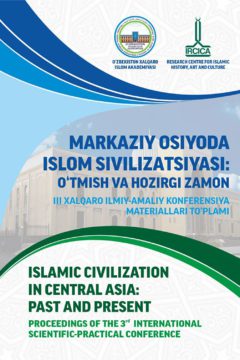
Proceedings of the International Conference: Islamic Civilization in Central Asia, Astana, 4-7 September 2007

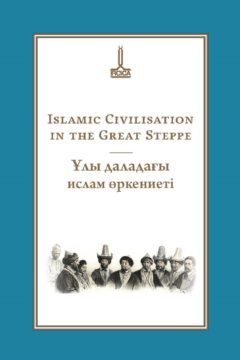
2 volumes, IRCICA, Istanbul, 2010; xxiv, 402; xxxiv, 427 pp.
Research and publications on the Islamic cultural history of the vast Central Asian region have been progressing outside of it as well as within. This is observed in the context of various social sciences but most notably in language studies, history of science, history of art and urban studies. Central Asia is one of the regions where Islam spread the earliest, from mid-seventh century onwards, and interacted productively with the local cultures. In consequence the region is marked by a multi-faith structure which produced intellectuals, philosophers and artists of varied cultural backgrounds. Within this framework, the Islamic culture that flourished here gave birth to eminent theologians and jurists, philosophers, astronomers and mathematicians. Some of the leading centers of civilization developed in Central Asian cities. Urbanism, scholarly and scientific activity in the region endowed its countries and peoples with a distinct cultural heritage that is reflected in the written works and the built structures. At the same time interactions took place with the neighbouring Arabic, Persian, Chinese and Russian cultures and civilizations. These and other multifarious aspects of Central Asian Islamic cultural history were addressed by the participants in the conference on Islamic Civilization in Central Asia which was held in Astana, Kazakhstan in September 2010. The conference was organized jointly by IRCICA on one hand and the Ministry of Foreign Affairs, the Ministry of Education and the Institute of Oriental Studies of Kazakhstan on the other. The President of Kazakhstan H.E. Nursultan Nazarbayev extended his patronage to the event; in his message to the participants which was read at the opening ceremony, President Nazarbayev stated “It is known that no social entity can understand itself without understanding other nations. Genuine tolerance stems from this background and it is a basis for interfaith dialogue.” The conference as a whole was indeed a contribution to intercultural and inter-faith understanding and dialogue since it increased the knowledge and references about the Islamic civilization in the region in its interactive dynamics with other cultures. The present book in two volumes records this contribution for the benefit of the world of learning. The first volume contains 31 papers presented in English and the second, 38 papers in either Russian or Kazakh. The message of President Nazarbayev, the address of OIC Secretary General Prof. Ekmeleddin İhsanoğlu, the welcoming remarks by the Minister of Foreign Affairs of Kazakhstan Mr. Marat Tazhin, and the address of IRCICA Director General Dr. Halit Eren the first volume and in Russian in the second volume.
Print
Tell a Friend
Increase font size
Default font size